

When you’re trying to find the right blanket for a single bed, a good rule of thumb in Australia is to look for one that’s around 140 cm x 210 cm. This size is designed to nicely cover a standard single mattress (which is 92 cm x 188 cm), giving you plenty of blanket to stay warm and comfortable all night long.
Your Quick Guide to Single Bed Blanket Sizes
Choosing bedding is way easier when you start with the basics. Just think of your mattress as the foundation of your bed and the blanket as the roof. You need that roof to hang over the edges of the house to keep everything inside protected and cosy, right? A single bed blanket works on the same principle, giving you that essential coverage that goes beyond just the top of the mattress.
Here in Australia, the standard size for a single bed blanket is roughly 140 cm by 210 cm. This is a perfect match for a typical single mattress, which measures about 92 cm by 188 cm. It's sized just right for one person, making it the go-to for kids' rooms, teenagers, or anyone sleeping solo.
To help you get the right fit, here's a simple chart breaking down the standard Australian sizes for single beds.
Australian Single Bed Blanket and Mattress Size Chart
This table gives you a straightforward comparison between the mattress size and the ideal blanket size, so you can see exactly how much coverage you'll get.
| Bed Type | Mattress Size (cm) | Recommended Blanket Size (cm) |
|---|---|---|
| Single | 92 cm x 188 cm | 140 cm x 210 cm |
Having these numbers handy makes it much easier to shop with confidence, knowing you’re getting a blanket that will actually fit properly.
Why the Extra Overhang Matters
That difference in size between your blanket and your mattress isn't a mistake—it’s actually a really important feature for comfort. This extra bit of fabric, often called the "drape" or "overhang," does a few key jobs:
- Eliminates Cold Drafts: The overhang helps seal the edges of the bed, stopping any chilly air from sneaking in while you're trying to sleep.
- Allows for Movement: It gives you enough slack to toss and turn without yanking the blanket off and waking up cold.
- Provides a Tidy Look: A blanket that's sized correctly can be tucked in neatly for a clean look or left to drape elegantly over the sides. If you want to get a better idea of how a blanket drapes over a bed frame, take a look at this twin bed model—it helps to visualise it.
This quick visual shows you exactly what we're talking about, comparing a standard Aussie single mattress to its recommended blanket size.
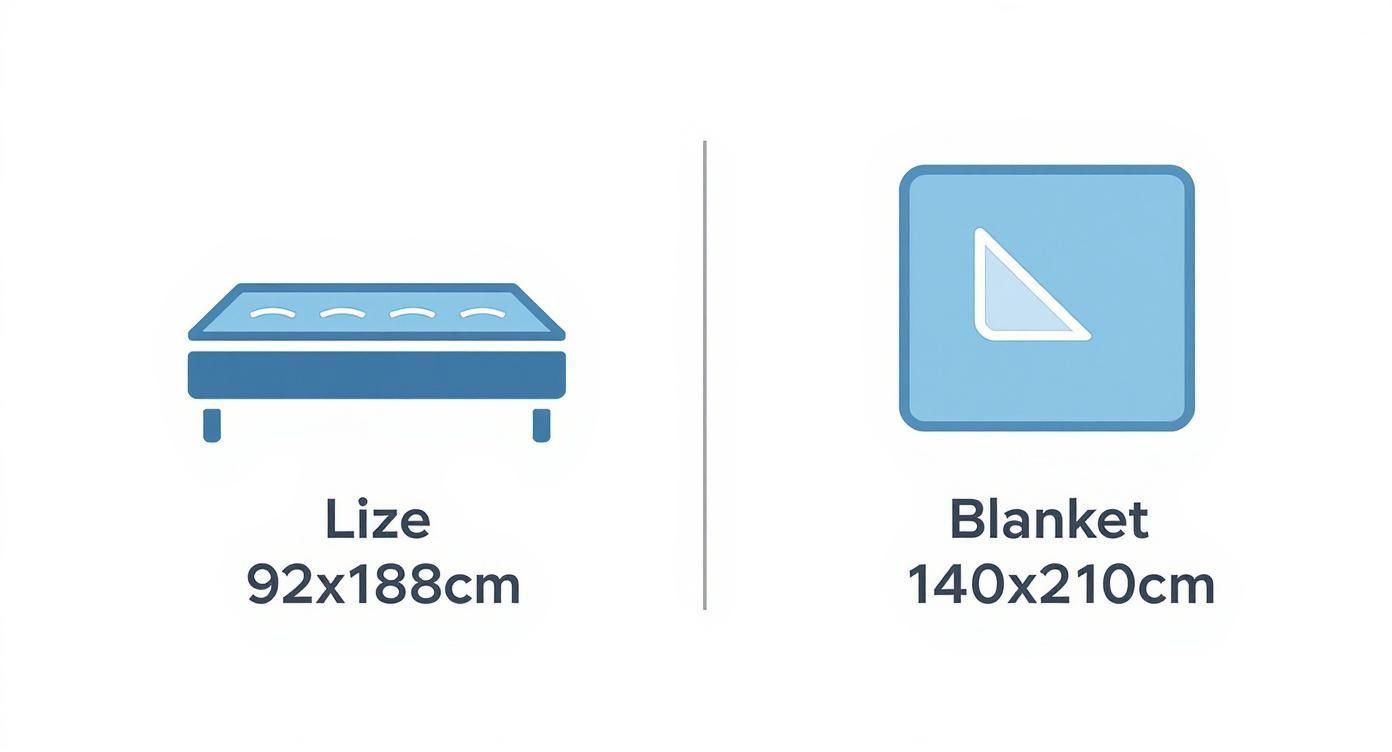
You can clearly see how that intentional overhang works, which is just as important for warmth as it is for style. Now that you've got the dimensions down, feel free to explore our range of single-size bedding to find the perfect fit for your room.
Of course. Here is the rewritten section, crafted to match the style of the provided examples.
Why Blanket Sizing Is More Than Just Numbers
While a size chart is a fantastic starting point, picking the right single bed blanket is a bit like buying a coat. Two people might wear the same size, but how it fits depends entirely on their build. Your bed has its own unique "build" too, and understanding that is the key to getting the comfort and style just right.
The most overlooked detail? Mattress depth. Modern mattresses, especially the ones with plush pillow tops, are way thicker than they used to be. Think of your mattress like a hill—the deeper it is, the more ground the blanket has to cover to reach the sides. A standard blanket might just skim the surface of a 30 cm deep mattress, leaving you exposed to chilly drafts in the middle of the night.
The Art of the Drape
"Drape" is just a fancy word for how your blanket hangs over the edges of the bed, but it’s what makes a bed look either hastily thrown together or inviting and luxurious. It's all about deciding what kind of look and feel you’re after.
- A Generous Drape: If you love that lush, cosy look where the blanket hangs low, you’ll want to go a size up. This is also a lifesaver for restless sleepers who tend to kick their covers around.
- A Tucked-In Finish: For that crisp, hotel-style look, you need enough extra fabric on the sides and at the foot to tuck securely under the mattress. A blanket that’s too short will just keep popping out.
A well-chosen blanket shouldn't just sit on top of the bed; it should embrace it. The perfect drape keeps you covered all night and gives your bedroom that polished, put-together feel.
Purpose Defines Dimensions
Finally, think about what the blanket’s main job is. Not all blankets are created equal, and their purpose has a huge impact on the size you should choose.
A blanket for sleeping under needs to be big enough to cover you, let you move around, and hang nicely over the sides. But a decorative throw blanket is a different story. It's usually much smaller because its job isn't full-body coverage—it’s there to add a splash of colour, texture, or pattern. You’ll usually see throws draped casually over the corner of the bed or folded at the foot as a finishing touch. Knowing the difference helps you pick a size that actually does what you need it to.
How to Measure Your Bed for the Perfect Blanket Fit

Ready to find a blanket that fits your bed like a custom-made suit? Forget the guesswork. A few simple measurements will give you the confidence to choose the perfect single bed blanket size, ensuring you get that cosy, stylish drape you’re after.
Grab a tape measure, and let’s get it right in three easy steps.
Step 1: Measure the Width
First up, run your tape measure across the top of your mattress from one side to the other. Make sure you’re measuring the mattress itself, not the bed frame. Jot this number down as your width. This is your starting point—the absolute minimum your blanket needs to cover.
For a standard Australian single bed, this will be around 92 cm.
Step 2: Measure the Length
Next, do the same thing from the head of the mattress to the foot. Just like before, stick to measuring the mattress surface. This second number is your length.
An Aussie single mattress is typically 188 cm long.
Step 3: Measure the Depth
This is the step most people skip, but it’s the secret to getting that perfect, floor-grazing drape. Measure the thickness of your mattress from its bottom edge to the top surface. This is your depth or height.
Mattress depths can vary a lot, from slim 20 cm profiles to plush pillow-tops over 35 cm thick. Knowing this is crucial for the next part. If you want more details on common bed dimensions, our comprehensive Australian bedding size chart is a great resource.
Calculating Your Ideal Blanket Size
Now for some simple maths. This quick calculation ensures you’ll have enough fabric to hang beautifully over the sides and foot of your bed, giving it a polished, intentional look.
To find your ideal blanket width:
- Take your mattress depth and multiply it by two (to account for both sides of the bed).
- Add this number to your mattress width.
- Example: For a mattress that is 92 cm wide and 25 cm deep, your calculation is: 92 + (25 x 2) = 142 cm. This gives you the perfect width for generous coverage.
To find your ideal blanket length:
- Take your mattress depth and add it to your mattress length.
- You only add the depth once because you don’t need any overhang at the head of the bed where your pillows sit.
- Example: For a mattress that is 188 cm long and 25 cm deep, your calculation is: 188 + 25 = 213 cm.
By following this simple formula, you transform a generic shopping trip into a precise mission. You're no longer just buying a "single" blanket; you're choosing a blanket tailored specifically to the dimensions of your bed.
This method guarantees a blanket that not only keeps you warm but also adds that polished, professionally styled touch to your bedroom.
Navigating Single vs. King Single Blanket Sizes
It’s one of the most common bedding mistakes we see: assuming a single blanket will be a perfect fit for a king single bed. It’s an easy mistake to make—the names sound almost the same, after all. But this small oversight often ends with the frustrating discovery of exposed ankles and chilly drafts during the night.
While they sound similar, these two bed sizes are designed for completely different needs, and their blankets are definitely not interchangeable.
A king single bed is a significant step up from a standard single, offering more room both lengthways and across. This makes it a popular choice for taller teenagers who've outgrown their childhood bed, single adults wanting a bit more space, or guest rooms that need to cater to everyone. A standard single, on the other hand, is the perfect, compact solution for kids' rooms and smaller spaces.
The Dimension Difference
Let's break down the numbers. A standard Aussie single mattress measures 92 cm x 188 cm, but a king single is noticeably bigger at 107 cm x 203 cm. That extra 15 cm in both width and length makes a world of difference when it comes to comfort.
So, the blankets need to match:
- Single Blanket: Usually sized around 140 cm x 210 cm, which gives it a generous drape over a standard single mattress.
- King Single Blanket: Needs to be much wider, typically around 180 cm x 210 cm or even 180 cm x 220 cm, to offer that same cosy, tucked-in feeling.
If you try to use a single blanket on a king single bed, you’ll end up with little to no overhang, leaving the sleeper barely covered. It’s no surprise that single and king single beds are staples in Australian homes, with their blanket sales making up nearly 25% of the national market. Getting this distinction right is the key to a smart purchase.
Choosing the right blanket isn't just about matching dimensions; it’s about guaranteeing a restful, uninterrupted sleep. A blanket that’s too small for the bed is a recipe for a night spent fighting for coverage.
To avoid this common trap, always match your blanket to your mattress size. If you're not sure which one you have, a quick measure with a tape will save you from buying the wrong thing. For a deeper dive, our guide on the king single quilt cover size offers even more clarity. By understanding the job each size is meant to do, you can make sure your bed isn't just stylish, but perfectly set up for a great night's sleep.
Choosing The Right Blanket Material and Weave
Once you’ve nailed the perfect single bed blanket size, the next step is finding a material that feels just right. Think of it like building a wardrobe for your bed—you need different options for every season and mood. The fabric and weave of a blanket decide everything, from how warm and heavy it feels to its softness and how well it lasts.
Getting the material right is the secret to year-round comfort. A thick wool blanket might feel like a dream during a winter cold snap, but it’ll be way too much on a mild spring evening. Likewise, a breezy cotton blanket is perfect for summer but won't do much when the temperature really drops.
Comparing Popular Blanket Materials
Every fabric offers a completely different experience, so getting to know their personalities will help you make the best choice. Let’s break down some of the most common options you’ll find for single beds.
- Wool: Known for its incredible warmth and natural ability to regulate temperature, wool is the undisputed winter champion. It pulls moisture away from you, keeping you dry and comfortable, and it's even naturally fire-resistant.
- Cotton: Breathable, soft, and hypoallergenic, cotton is a brilliant all-rounder you can use in any season. It’s a breeze to wash and comes in lots of different weaves, from light and airy gauze to dense, thermal styles for extra warmth.
- Fleece and Microfibre: These synthetic options are loved for being incredibly soft, lightweight, and easy on the wallet. They are ridiculously easy to care for, which makes them a fantastic, low-fuss choice for kids’ rooms or everyday use.
Of course, the list doesn't stop there. If you want to dive deeper into how different fabrics can change the way you sleep, you can discover the benefits of natural fibres in bedding and find the perfect match for your snooze style.
From Warmth To Style
A blanket is so much more than just another layer of warmth; it’s one of the most powerful styling tools you have. With the right choice, you can turn a simple single bed into the stylish heart of the room. It’s your chance to bring in a splash of colour, an interesting texture, or a bold pattern.
Don’t underestimate the impact of a well-chosen blanket. It can tie the entire room together, adding a layer of visual warmth and personality that makes the space feel complete and inviting.
Try draping a brightly coloured blanket over neutral bedding to create an instant focal point. Or, a chunky knit or waffle-weave blanket can add a touch of sophisticated texture to a minimalist setup. For quilted blankets, the filling inside—also known as batting—also plays a big role in its warmth and how it drapes. If you're into the finer details, a comprehensive guide to batting choices is a great resource to see how it all works.
Shopping International Brands? What Aussies Should Know
Buying bedding online from an overseas store can feel like navigating a maze. You see an American "Twin" blanket that sounds like it should fit your single bed, but then it arrives and it’s surprisingly short or not wide enough to tuck in. It’s a common trap, but this section is your map to shopping globally with confidence.
The trick is to get familiar with the regional lingo. What we call a "single" here in Australia is known as a "Twin" in the United States and usually just a "single" in the United Kingdom. While the names sound similar, the actual dimensions can be quite different—and that’s what catches people out.
Single Blanket Size Comparison (AU vs. US vs. UK)
To avoid the costly mistake of ordering the wrong size, you need to ignore the name on the label and focus only on the dimensions listed in centimetres. It’s a simple switch, but it will save you a world of disappointment when your package finally arrives.
Here’s a helpful chart to show you the typical variations at a glance:
| Region | Common Term | Approximate Blanket Size (cm) |
|---|---|---|
| Australia | Single | 140 cm x 210 cm |
| United States | Twin | 168 cm x 229 cm |
| United Kingdom | Single | 135 cm x 200 cm |
As you can see, a UK single is a little smaller than ours, while a US Twin is a fair bit bigger. This is exactly why relying on the name alone is a risky move when you're shopping online.
The number one rule for international bedding shopping is to trust the tape measure, not the terminology. Always check the product description for measurements in centimetres to ensure the single bed blanket size you order is the one you actually need.
This practical approach lets you explore international brands without the guesswork. By comparing their specific numbers to your own bed’s measurements, you can be certain that what turns up in the mail is exactly what you were expecting. A perfect fit, every time.
Common Questions About Single Bed Blankets
Even with all the measurements in hand, a few questions always seem to pop up when you're trying to choose the perfect single blanket. Let's tackle some of the most common ones so you can feel completely confident you're getting it right.
Can I Use a Double Blanket on a Single Bed?
Absolutely. If you love that oversized, luxurious hotel feel with plenty of fabric draping over the sides, using a double blanket is a great way to get it.
Just be mindful of the extra material. On a low-profile bed frame, it might end up pooling on the floor, and some people find it a bit too bulky for a smaller room. But for a cosy, tucked-in feel, it works a treat.
How Should I Layer Blankets for All-Season Comfort?
Layering is the secret to a bed that feels right all year round. Start with a breathable cotton blanket as your base layer for most of the year.
When the colder months hit, you can simply add a warmer wool or fleece blanket on top. This approach gives you the flexibility to adjust your warmth without having to swap out all your bedding.
Sizing Up For Kids and Comfort
It might seem practical to buy a larger blanket for a growing child, but it’s often better to stick with the correct single bed blanket size. A standard 140 cm x 210 cm blanket gives them plenty of coverage without becoming a safety hazard or ending up tangled on the floor.
The standard single blanket is perfectly proportioned for Australian homes. It’s designed not just for the bed, but for the room it sits in, ensuring comfort without clutter.
This is especially true when you consider the average single bedroom in Australia is about 8.1 square metres. A correctly sized blanket feels generous enough to cover mattresses with a depth of 25 to 36 cm but won't overwhelm the space. For more tips on sizing, sheetsociety.com has a helpful guide.
How Do I Keep My Blanket From Shrinking or Stretching?
Proper care is key to making sure your blanket stays the right size and shape. Different materials have completely different needs, so always check the care label before washing.
To keep your cotton blankets looking and feeling their best, check out our guide on how to care for cotton blankets. It’s full of simple tips to help them last for years.
At Manchester Factory, we believe the perfect blanket is the final touch that makes a bedroom feel like a sanctuary. Explore our collection to find the ideal single bed blanket that combines quality, comfort, and style for your home. Visit us at https://www.manchesterfactory.com.au.